INDUSTRY
Education
CLIENT
Alberta Teaching Profession Commission (ATPC)
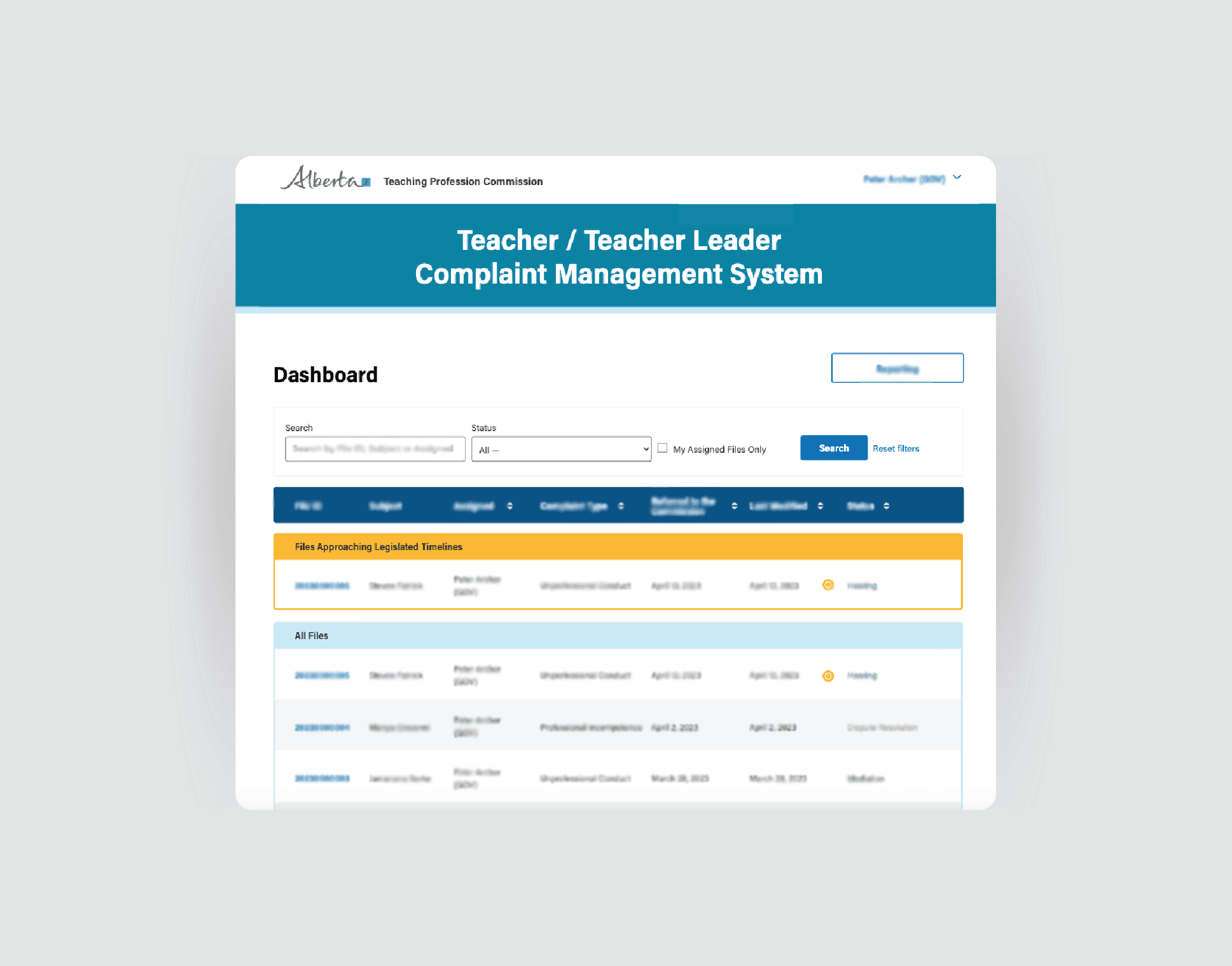
Complaint Management Platform

From administrative burden to transparent oversight
The Alberta Teaching Profession Commission (ATPC) was established to oversee disciplinary processes for teachers and school leaders across the province. As a newly formed regulatory body, ATPC required a digital service that could support complex complaint workflows while maintaining the highest standards of confidentiality, fairness, and transparency.
The Government of Alberta needed more than a system, they needed a service designed to reflect how disciplinary processes operate in practice, while improving efficiency and strengthening public trust.
Number 41 partnered with the Province to design and deliver a modern complaint management platform, creating a secure and scalable foundation for managing educator discipline.

The challenge
Disciplinary processes are inherently complex, involving multiple roles, sensitive information, and strict procedural requirements.
The system needed to support the full lifecycle of a complaint, from intake through investigation, adjudication, and reporting, while ensuring that information was handled securely and that workflows remained consistent and defensible.
At the same time, staff required tools that could reduce administrative burden and improve visibility across cases, without introducing additional complexity.
The challenge was not simply to build a system, but to design a service that balanced usability, operational efficiency, and regulatory integrity.
Our approach
Number 41 led a design-led delivery approach, working closely with stakeholders to understand how disciplinary processes function in practice.
We began by mapping the full complaint lifecycle, using service blueprints, journey maps, and workflow models to define a clear future-state service. These artefacts helped identify inefficiencies, clarify roles, and align stakeholders around a shared vision.
In parallel, we developed high-fidelity, interactive prototypes to simulate key workflows such as complaint intake, case management, and reporting. Usability testing with internal staff ensured that the experience reduced complexity and aligned with real operational needs.
At the same time, our design and technical teams worked together to define system architecture, data models, and security frameworks, ensuring the platform would support both user needs and regulatory requirements.
This approach ensured that both the experience and underlying system were validated before development began.
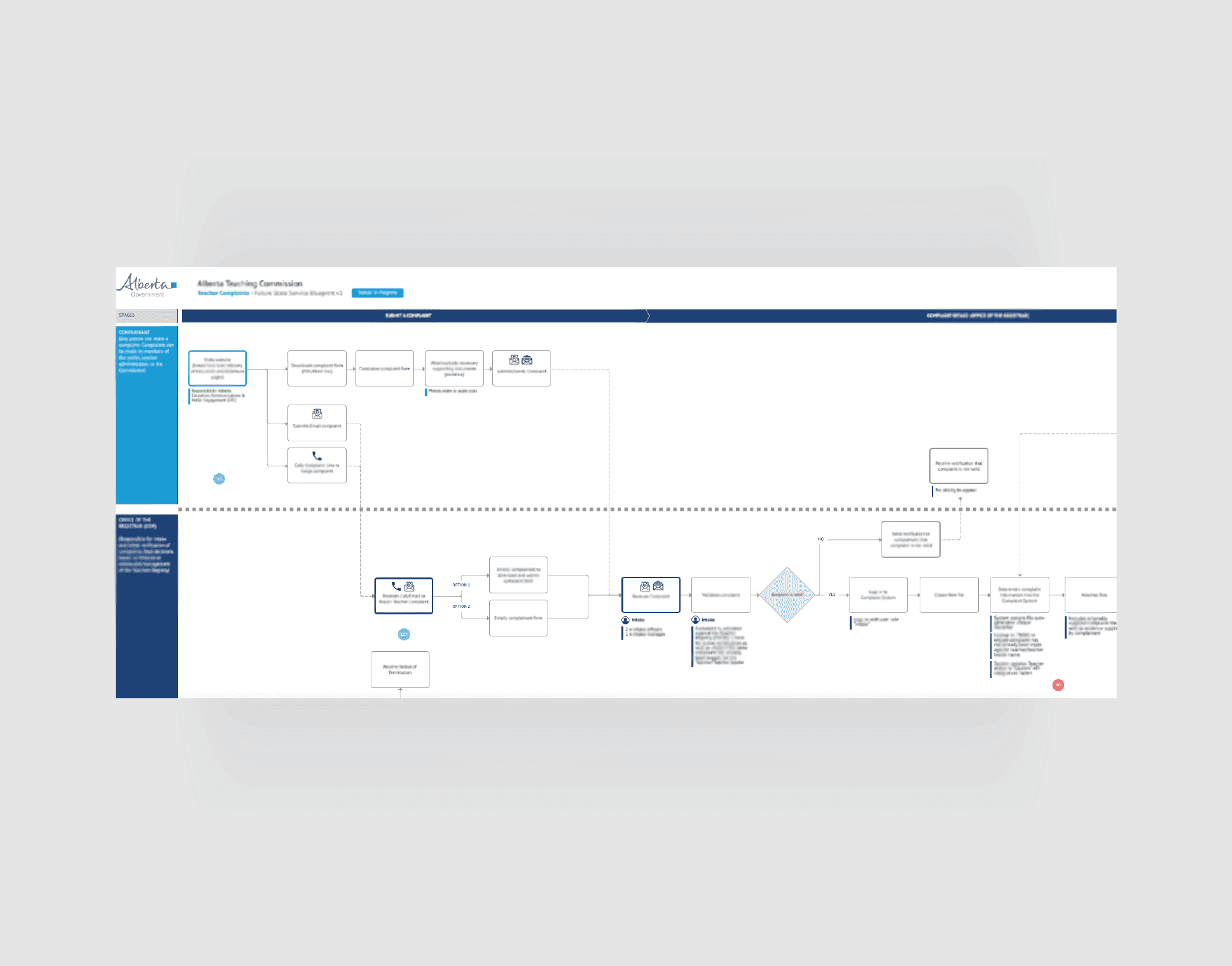
Blueprint future state version 1.
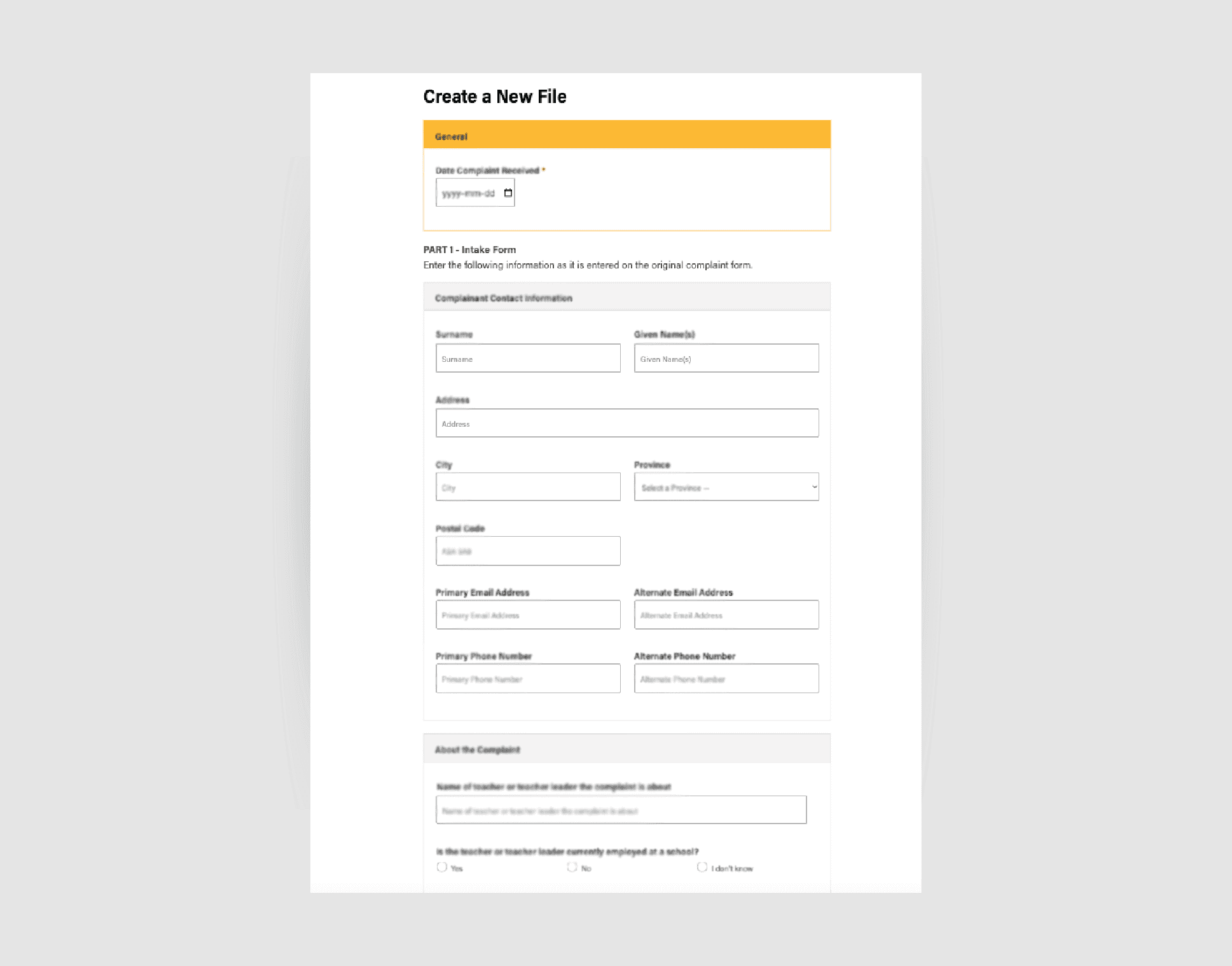
Low fidelity wireframe to replicate create a new file.
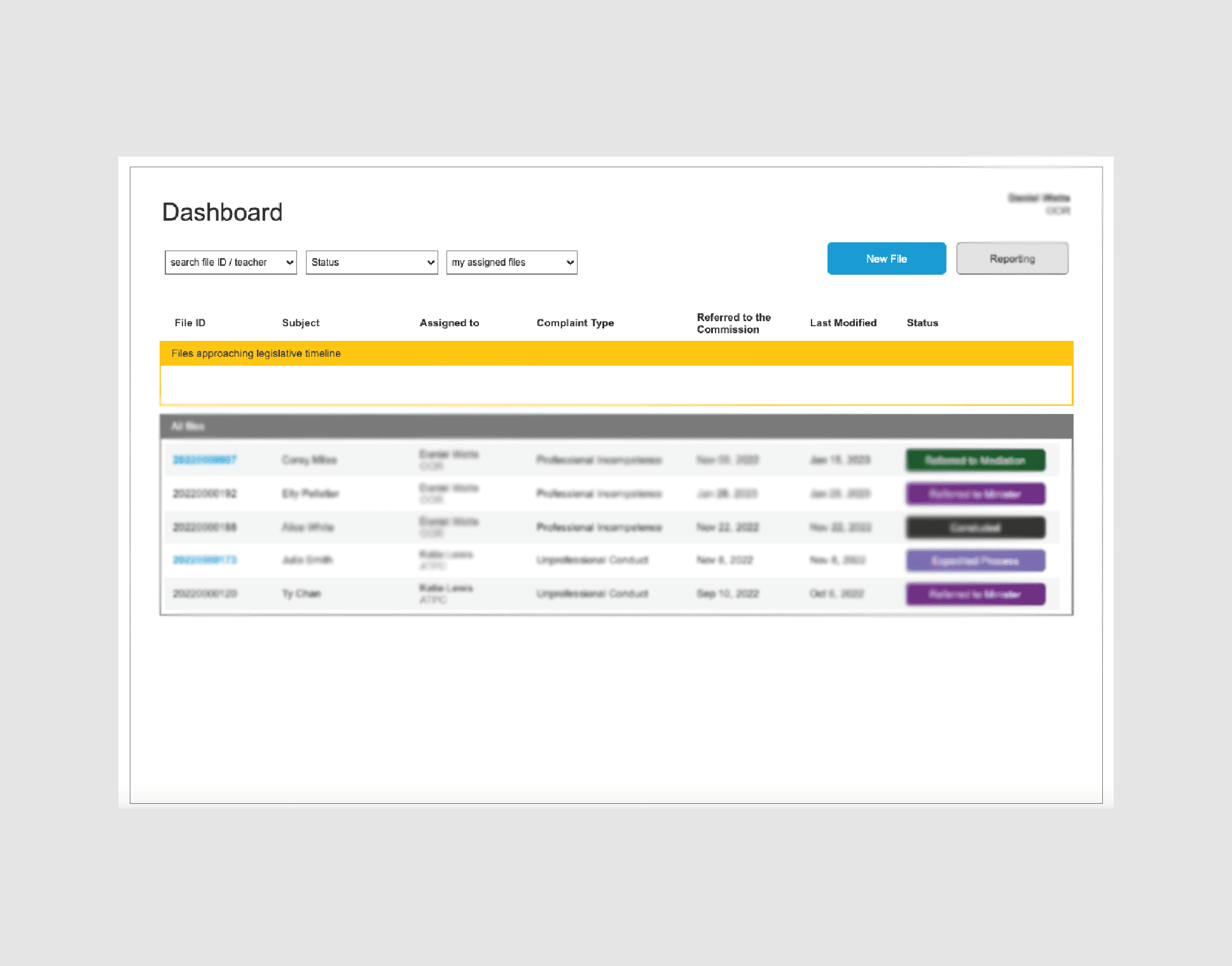
Initial concept of a dashboard layout to start conversation.
The Solution
The result is a secure, integrated digital platform that supports the full lifecycle of educator disciplinary processes.
The platform provides structured workflows for complaint intake, case management, and reporting, enabling staff to manage complex cases with greater clarity and efficiency. Role-based access controls ensure that sensitive information is protected, while supporting collaboration across different user groups.
Built using modern, cloud-based technologies, the solution is designed for scalability, reliability, and long-term sustainability. By aligning the digital experience with operational processes, the platform supports both usability and compliance.
Outcomes
The ATPC platform establishes a modern, secure foundation for managing educator disciplinary processes in Alberta.
Staff are better equipped to manage cases efficiently, with improved visibility and streamlined workflows that reduce administrative burden. At the same time, the system ensures that sensitive information is handled appropriately and that processes remain consistent and defensible.
The platform supports greater transparency and more effective reporting, helping to strengthen trust in the disciplinary process.
What was once a complex and manual set of processes has been transformed into a cohesive, digitally enabled service, demonstrating how a design-led approach can modernize critical regulatory systems while maintaining integrity and accountability.